 Born to Life
February 2, 1924
Ingleside, Colorado
Reception
June 13, 1942
Born to Eternal Life
March 18, 2026
Our Lady of the Angels,
Milwaukee, Wisconsin
Interment
Mt. Olivet Cemetery
Greenfield, Wisconsin
Written by S. Marietta Hanus
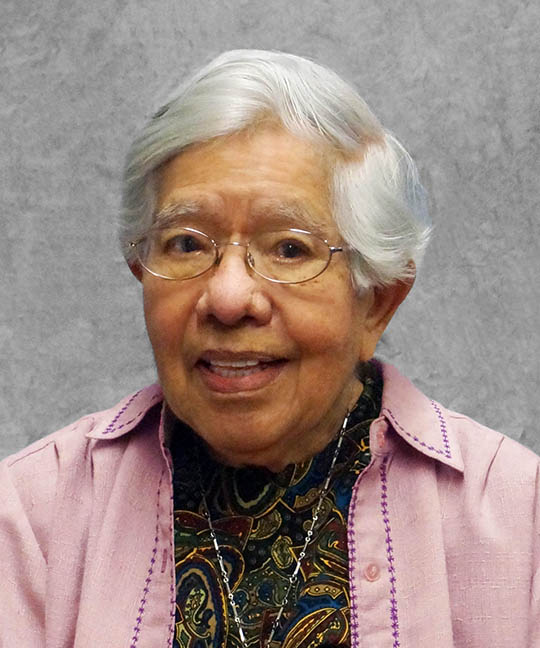
Mary Garcia was born on February 2, 1924, in Ingleside, Colorado. She was one of 12 children of Mexican immigrants, four of whom died in infancy.
Her childhood prepared her for a simple lifestyle. When her father was injured working in the limestone mining camp at the foot of the Rocky Mountains, the family rented a simple home in Fort Collins. From spring to November, the family would leave Fort Collins to work on the sugar beet farms from early morning to late afternoon, thinning the beets, weeding, and harvesting them. They migrated from farm to farm, living in the farmhouses. From November to spring, the children would go to Holy Family Spanish parish school.
The family experienced discrimination in Fort Collins. The last pews in the Catholic Church were for the Mexican families. There were signs in the stores: “No Mexicans allowed.”
At age 15, Mary and her 17-year-old sister Frances graduated from eighth grade. Having read the stories of Maryknoll missionaries in school, they wanted to become sisters to help many people. They wrote to many religious communities. The Our Lady of Victory Missionary Sisters accepted 17-year-old Frances. Mary wrote to Mother Stanislaus in Milwaukee when she heard that the School Sisters of St. Francis would accept her at age 15. Although it was difficult for the family to lose two daughters, they blessed her saying: “We have given you to God.”
On November 17, 1939, Mary traveled alone on the train to Chicago. From there, a sister accompanied her to Milwaukee. As an aspirant, she was overwhelmed by the size of St. Joseph Convent, the black clothes, the German food, and being the only Spanish-speaking person. She later wrote, “God's love for me and my desire to serve gave me strength and determination.” Upon finishing high school at the convent, she was received in June 1942 and given the name Sister Mary Joaquin. After making her first vows in 1944, she was sent to teach second grade at Little Flower School in Wauwatosa.
At age 21, Sister Joaquin was sent to help in the orphanage in Tegucigalpa, Honduras, to take the place of a deceased German sister. During World War II, Honduras was at war with Germany and no other German sisters were permitted to come. The sisters spoke German among themselves and prepared German food. This was difficult for Sister Joaquin.
She taught 36 Honduran girls and became director of the school. During the following years, she also taught religion and writing to adults and catechized in two barrios and at the cathedral. During vacation she went to the Department of Yoro to catechize, help with baptisms and teach songs. She lived the reason she had come to the convent: "to help people."
When she was 30, Sister Joaquin returned to Milwaukee to finish her college degree and prepare to be the formation director for postulants and novices in Costa Rica. A decision had been made to no longer send them to Milwaukee for their formation but to open a formation house in Costa Rica, along with a bilingual high school for girls. Sister Joaquin was one of the four sisters who started the first mission in Costa Rica, St. Clare College, adapting to yet another culture. For four years she worked with those in formation, taught school, and translated for the other sisters.
Returning to Honduras at age 36, she was asked to be the acting director of the first Honduran co-ed elementary parish school in Comayagua. She also taught religion and English and trained parish catechists. Later she served as director of the co-ed parish school in the mountainous village of Minas de Oro, and taught religion classes for the children in the public school and evening Bible classes for adults.
In 1966, Sister Joaquin went to the Diocese of Olancho to help the newly appointed Bishop Nicholas D'Antonio in pastoral work. She recalls this time as the most meaningful time in her missionary life. The Department of Olancho was primitive, far from the capital. The poor people were exploited by the powerful. There, Sister Joaquin prepared the elementary school teachers to teach religion. This was permitted by the government. She also collaborated with others in preparing seminars for teachers of the eleven zones of Olancho.
The Diocese of Olancho took seriously the “preferential option for the poor.” This was the direction of the bishops of Latin America who met in 1968 in Medellin, Colombia, following the Second Vatican Council. Bishop Nicholas asked Sister Joaquin (now Sister Mary) and Sister Mary Ann Samol to help in evangelization and human promotion in the diocese. They worked with missionaries from France, Canada, Colombia and other countries. Mary was active in preparing leaders for the Celebration of the Word of God in their villages, Bible Circles, Radio Programs, and Radio School monitors. She administered the Apostolic Center, which provided pastoral materials.
During the Civil War between Honduras and El Salvador, the sisters visited homes to promote peace and stop deportations to El Salvador. Therefore, they were considered anti-patriotic and Communists. The training of lay leaders and literacy programs were good news for the poor, but those in power saw this work of the Church as subversive. The poor could no longer be exploited.
When a national peace march of campesinos (poor people) was organized for June 25, 1975, to ask for an application of the agrarian laws, the military government, landowners, and cattlemen responded violently. They blamed foreigners for instigating the peace march. That day, 14 people, including two priests, were killed in the Juticalpa Diocese. Sister Mary was taken prisoner for a night and a day and then flown to the capital, where she was to pick up her passport for deportation. Upon her arrival, she quickly called our sisters and the archbishop to advise them of what had happened in Olancho. Sister Mary remained under house arrest at our mission, Casa Clemens. While there, she wrote a chronicle of all that was happening.
Sister Mary left Honduras for several months and then returned to Olancho for six months accompanied by Sister Ruth Vasen. She reopened the Apostolic Center. However, she was suffering from Bell's Palsy and had to return to the United States for a year. When she returned to Honduras in March 1979 for several months, she trained the people to take over preparation for the sacraments and lead the Bible groups. She thanked God for her 12 years of working with the poor of Olancho. It gave her a deep sense of the presence of God.
Sister Enelly Ortiz, who is from Olancho, sent this reflection about Sister Mary on behalf of all the sisters of the Latin American Region:
“To speak of Mary Garcia is to speak of a simple, humble, determined woman, fully committed to what she set out to do; a sister who completely shared the faith of the poor people, especially during the time she served in the Department of Olancho. Of the 28 years she served in Honduras, 12 were in Olancho, sharing the life and culture of the Honduran people. She accompanied Monsignor Nicolas D'Antonio for 25 years while he was in Comayagua.
“She dedicated herself to the poor people in Olancho, where she witnessed the suffering of the campesinos. She worked tirelessly so that the people could have health, education, and better living conditions. She organized community groups so that people could be evangelized and have real participation in the Church and greater dignity.
“She shared life with the rural people, visiting them and accompanying them at meetings, at workshops for teachers and monitors of the radio schools, and for the pastoral agents of the Church, known as “delegates of the Word of God.”
“Sister Mary Garcia was a witness to the persecution of the Church in Olancho in the 1970s by the military and local landowners. She had to leave after two major massacres in Olancho, La Tanquera and Los Horcones. After her departure, the people remembered her very fondly, and whenever she had the opportunity to travel, Sister Mary would visit them. She was a very approachable sister who always showed her appreciation for each sister in the Latin American Region.”
After 31 years of missionary life in Latin America, Sister Mary returned to the United States. Beginning in 1980, she continued her intercultural ministry in New Orleans. For eight years she worked again with Bishop Nicholas as bilingual secretary and with those in charge of parish ministries. During this time, she also assisted the International Leadership Team as translator.
In 1988, Sister Mary was elected as one of the vice presidents of the School Sisters of St. Francis congregation, and she was reelected in 1992, serving the congregation for eight years. During this time, she visited our sisters in ten countries, including India. Her visits to Alaska and Peru were especially memorable.
After completing her term, she returned to her hometown, Fort Collins, for 17 years, helping in parish ministry to the Spanish speaking, especially adult faith formation. She lived in an apartment complex for low-income people of several cultures and religions, sharing life and her garden produce with them, accompanying the dying, and writing three books: the story of her family; My Weaving, the story of her life; and A Church that Lived its Commitment to the Poor.
In 2013, Sister Mary retired to St. Joseph Convent in Milwaukee and later to Our Lady of the Angels Convent in Greenfield, where she reflected and prepared for her final journey. She leaves as a legacy to her sisters a life of zeal, courage, and determination. Living a simple Gospel lifestyle, she exemplified what it means to respond to the needs of the time and live in solidarity with the poor.
Her frequent prayer was, “I lift up my eyes to the mountain from whence shall help come to me. My help is from the Lord who made heaven and earth.”
Thank you, Sister Mary, for listening to God's call in your life.
Join Us in Remembering
Sister Mary
We encourage you to share your loving memories of Sister’s life and ministry using the online form on this page. Your submission will be reviewed by the community and posted to this page promptly.
Name:
Email Address:
A Recording of Sister’s Funeral Mass is Available for Viewing
You may watch a videorecording of Sister’s Funeral Mass on our Ustream channel: https://video.ibm.com/recorded/134768441