
St. Anthony of Padua
By Marilyn Bowers Gorun
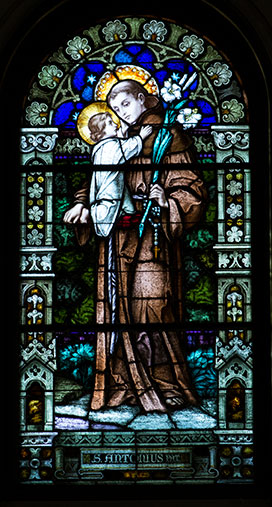 Fernando Martins de Bulhões was born in Lisbon, Portugal, near the end of the twelfth century. He came from a wealthy noble family and received his early education at the cathedral school. At fifteen, he began his training as a canon regular in the Order of the Holy Cross.
In those days, men could be ordained at a fairly young age, so Fernando was ordained at nineteen and assumed the role of guest master at the abbey where he resided. Soon after, a group of Franciscan Friars, whose order had begun only eleven years before, built a hermitage nearby. After five Franciscans were martyred in Moracco, their bodies were buried at Fernando’s monastery.
Greatly inspired by these men, Fernando asked for and received permission to join the Franciscan friars. He took the name Anthony, which was the name of the chapel at the hermitage he joined. Following the example of the martyrs, he set sail for Morocco. However, he became quite ill and had to return; when the ship stopped in Sicily, Anthony stayed ashore. He joined other friars in Tuscany, where he regained his health and pursued further studies. At some point he met St. Francis and found common ground with him regarding the education of young friars who were preparing for ordination to the priesthood. In a short time, Francis put Anthony in charge of their studies.
Many people pray to St. Anthony to help them find missing items. The story told is that Anthony had a handwritten Psalter [Book of Psalms], with his notes and comments in it, that was stolen by a novice who was leaving the community. After Anthony prayed for its return, the young man came back, gave him the Psalter, and rejoined the friars. The book is still in the friary in Bologna.
One prayer seeking St. Anthony’s intercession reads: “O Holy Saint Anthony, patron of lost things, I am in urgent need of your intercession. Please pray for me and help me find what I have lost. Through your prayers, may my need be granted. Amen.” More commonly, “Tony, Tony, turn around; something’s lost and must be found.”
Anthony was a novice master, a teacher, a preacher, a provincial superior, and a papal envoy at various times in his short life. He died at the age of thirty-six and was buried near Padua. A year later, he was canonized a saint. In 1946, he was named a Doctor of the Church. He is the patron saint of numerous groups and cities. Paintings and statues of St. Anthony usually picture him holding a lily and the Baby Jesus, often also a large book.
Image: High in the sanctuary of St. Joseph Chapel